I love to write. I may not be a great writer, but I love the process of seeing thoughts take on some discernable form and being made available to anybody who cares to read them. I love writing. There is something about picking up a text and knowing that the moment of its creation is being shared across time with somebody who cared enough to read what was written that I find intoxicating. I am not a profound thinker. Nor am I a great poet – I do struggle to find the right word – that warrants publication for the ages. No, I am common. But I love to write.
The problem is that I have a very full schedule. I also love to play music. Music takes work. Wood-shedding is a lonely process of repetition until the riff sounds like music. It is painful. It is hard. But it is the price of making music. I can’t play an instrument if I don’t practice until the riff is under my fingers without the need to think. It has to be as fluid as speech.
And there is the irony.
Speech is not easy, either. It is not enough to have something to say. We all have something to say. It has to be said in a way that warrants the attention and honors the gift of the reader’s time. Writing requires practice. Writing requires wood-shedding, as well. There is a rhythm to good writing, a flow that feeds the imagination of the reading, using words like strings and drums, leading the reader into the mind and heart of the writer. This is where poetry and music coalesce into song. By song, I don’t mean the majority of the crap that passes for music on the pop charts. I am looking for something that is more beautiful, more honest, more passionate still.
Art is not easy. It is a harsh and demanding mistress that requires time, effort, pain and ultimately the soul of the artist. It is a bargain with a devil that tempts like fire tempted Prometheus asking if you are willing to allow the eagle eternally to peck at your liver so your sister and brother may take fire for granted. And so it is that some of us are seduced by the siren sound of the call to be an artist.
I have to practice. I am driven, compelled, to make my music better still. And I love to write.
August 27, 2007


July 24, 2007
Sex Offenders?
Let’s be honest: I am a leftist, a true liberal to my core. But there are some things that must be enforced: the right to one’s person is part of a free society. We are our own property; our bodies are not the property of the State, the Church, or God or the Devil. I believe that laws regarding the violation of a person’s sexual boundaries are well placed and deserve to be fairly enforced. I am the father of daughters: God help anybody that hurts them. I may be a leftist, but I would become the very hammer of God where their welfare is involved.
An item on the news today: a middle-school boy was charged with a felony – yes a felony – for having playfully smacked a girl on her bottom. Was this appropriate behavior? No and Yes. Preadolescence is where we learn about our bodies and sexuality; should a person be touching another person’s “intimate body parts”? That is a matter of consent. Kids do dumb things. They touch each other and begin to learn what is appropriate and in what context. Context and relationship make all the difference.
To have charged this child with felony sexual battery is the triumph of the absurd. I’ve watched kids this age. Both sexes do things that they would be less apt to do later in life unless they understood that there was consent. A boy smacks a girl on the butt and he is a rapist? Pardon my Y-chromosome, but doesn’t this trivialize rape?
I had a friend who was raped. She was a friend; trust was part of our platonic relationship. There was nothing trivial about the pain or the humiliation that she felt. It took her at least a year to be able to think about sex without violence being attached to it. This was terror and theft of that which was most intimate and personal. We trivialize the most revolting acts by lowering the bar that defines what is truly horrid and what is merely in bad taste.
We have to get past our cultural pre-pubescence and see that sex is natural and good. The natural process of development is not a bad thing. We all have done some dumb things. I smacked a girl on her bottom, made jokes about tits, talked about what I wanted to do in the locker-room like all boys that age did. But that does not make me a sexual predator; it made me a thirteen year old boy that was curious about girls, who were curious about boys.
If there was a rape with that incarceration it was a rape of justice and a slap in the face of people that have suffered sexual violence.
Ah, but I am only a fool…
An item on the news today: a middle-school boy was charged with a felony – yes a felony – for having playfully smacked a girl on her bottom. Was this appropriate behavior? No and Yes. Preadolescence is where we learn about our bodies and sexuality; should a person be touching another person’s “intimate body parts”? That is a matter of consent. Kids do dumb things. They touch each other and begin to learn what is appropriate and in what context. Context and relationship make all the difference.
To have charged this child with felony sexual battery is the triumph of the absurd. I’ve watched kids this age. Both sexes do things that they would be less apt to do later in life unless they understood that there was consent. A boy smacks a girl on the butt and he is a rapist? Pardon my Y-chromosome, but doesn’t this trivialize rape?
I had a friend who was raped. She was a friend; trust was part of our platonic relationship. There was nothing trivial about the pain or the humiliation that she felt. It took her at least a year to be able to think about sex without violence being attached to it. This was terror and theft of that which was most intimate and personal. We trivialize the most revolting acts by lowering the bar that defines what is truly horrid and what is merely in bad taste.
We have to get past our cultural pre-pubescence and see that sex is natural and good. The natural process of development is not a bad thing. We all have done some dumb things. I smacked a girl on her bottom, made jokes about tits, talked about what I wanted to do in the locker-room like all boys that age did. But that does not make me a sexual predator; it made me a thirteen year old boy that was curious about girls, who were curious about boys.
If there was a rape with that incarceration it was a rape of justice and a slap in the face of people that have suffered sexual violence.
Ah, but I am only a fool…
July 22, 2007
Loyal Opposition?
Applied Dialectic
The object of a rational dialog is to resolve a disagreement through a logical proposition of thesis and antithesis to reach a synthesis: that is some resolution that is both reasonable and regards the original proponent’s viewpoints. This seems to be central to the ideals of our constitutional republic: we have a system that is filled with checks and balances. This is not terribly effective if measured in terms of hasty completion of tasks, but does tend to create points of dialog where truth may be discovered. Any dialectic method has, as its aim, the discovery of a common truth that may not be self-evident and requires a good deal of parsing to discover.
The fact that dialectic supposes opposition suggests that the confrontation is not a bad thing; quite to the contrary, it warns against the presumption of absolute knowledge of truth by requiring that any supposition of justice be subject to the test of loyal opposition. For any dialectical method to function there must be an advocate of the antithesis, that is to say an opposing viewpoint.
Accountability: Checks and Balances
Since when is calling our leaders to account for actions taken on our behalf – Do you recall the creation of a government by and for the people? – an unpatriotic act? Apparently this is the position of our current administration. Senator Hillary Clinton was rebuked by the Under Secretary of Defense, Eric Edelman, for asking questions deemed to be inappropriate: "Premature and public discussion of the withdrawal of
In a free and democratic society public servants are free to speak their minds. This means that a spirited public debate is necessary to hear all points of view. It would seem that if there is any image to bring to the so-called enemies of freedom it is this: a great nation is open to dialog. I wish that I recalled who said it: In a war, the first casualty is the truth.
Beware of Absolute Loyalty
I fear for the welfare of my children when I hear our government demanding absolute and unquestioning loyalty to an ideal proposed by those in power. How dare they make this demand? And why are we not demanding their removal when it is made? This is not an issue of left and right, conservative and liberal: it is an issue of truth. Anybody that dares to question one’s loyalty because the veracity of our leaders has been called to account is a dangerous fellow that needs to be brought out of the shadows and into the light to be seen for what he or she is. The way that this is done is to dare to ask the questions and question the answers.
Dissent is the most American of virtues. I prove my loyalty by my dissent. I prove my patriotism by demanding accountability. Democracy is difficult. It presumes that we cherish the freedoms that define us as a nation. It presumes that we will work to make our legacy to our children this great democratic experiment that we call
Who knows, maybe they found Bush’s brain right next to the WMDs that were the reason for the war. They were right next to Osama Bin Laden’s hideout deep in the imagination of those who feel that mere bluster is an argument that will persuade. Ask the question. Question the answers.
Ah, but I am only a fool…
July 05, 2007
A rumination at my desk
OK… Fair enough: Six months is a long time to go without writing. I have been on a hiatus from daily ruminations. Life is good, but I’ve been busy getting my feet back under me. I realized that it has been this long when I tried to make a post on YouTube only to learn that my ‘blog had fallen into the nether world of ignored internet sites. Even now I am certain that I am the only person reading these words. Still, it was once well read and it began with one person reading it. So what can happen once can happen again…
***** ***** *****
The United States has won the world’s record for speed eating. This is a competition that can only be waged by a nation or nations that are not only consumerist in their orientation, but have enough food to waste in such trivial pursuits. I kept wondering about people starving in this country. I’ve seen enough overweight homeless people to know that not all that lack shelter lack food; but there is extreme poverty in this country and poverty that goes to the point of being obscene in the world. Are there not famines enough to make one take a moment’s pause and wonder about the sheer decadent excess of such a thing?
***** ***** *****
Scooter Libby has had a commutation of his sentence. Bushy-boy apparently thought that his family had suffered enough and that it was an excessive sentence for having participated in the lies and prevarications that led to the Iraq war. Out an operative of our intelligence community for political aims and look forward to a commutation and a potential pardon. What about all of the people that were executed under Bush’s administration when he was the Governor of Texas? I suppose that their pain was not really the point. They might have killed one or two people. Kill the fuckers…. To hell with the pain their families feel. If you are to be pardoned you have to contribute to the terror that is war waged on the basis of a lie: make no mistake, our President bears responsibility for the deaths of over 3,000 American soldiers, to say nothing of soldiers from the “coalition of the willing” and those Iraqis that have lost their lives. But Lewis Libby has a cool nickname that makes him sound like a kid with freckles, a missing front tooth, in a baseball cap, riding a skateboard… There is Americana in that name. So what the hell… (read these last few lines with a voice dripping with sarcasm).
***** ***** *****
I’ve been playing the acoustic bass lately. I got an upright and am relearning my instrument. All of those low rumbles in Ventura are probably me making horrid noises with an instrument that is as tall as I am and equally wide. My cat loves to come in when I practice: he meows in Bb and has perfect pitch.
More later, and sooner…
More later, and sooner…
January 04, 2007
Relationships, the Past, and a Course for the Now
I’ve Been Thinking About My past: a bit of historical reflection allows course correction for the future. Specifically, I’ve been thinking about my past relationships. I am aware that the one constant in all of the failures and successes that I’ve had has been me. There are things that I do very well in relationships and things that I have not done as well.
Six Feet Under
Lately, I’ve found myself hooked on Six Feet Under. There was a scene when Ruth and her new husband are making love. They are celebrating their union with carnal bliss, lust that filled their cups and overflowed down the halls into the rooms where their adult children were sleeping to be disturbed by the sounds of geriatric orgasms. That began my thinking: there were relationships that I had where the sex was the stuff that gods only dreamed of, carnality elevated to a point where flesh and spirit merged into something well beyond either. SL and I enjoyed this sort of lusty life. So did LA and I, though less frequently, so did DP and I. But the problem with all three of these relationships was that the passion was explosive and also spilt over into other parts of our lives that could have benefited from a more prosaic and detached relating that would have been a bit more boring, but certainly more peaceful.
I am a passionate person: not simply a sexual person, but a person that is full of emotional dynamite that is easily set off. The emotional connection that translated into free and experimental sexual expression wanted also to be translated into paying the bills or taking out the trash. It was the living together that I found so hard, the daily minutiae that needs must be attended to in order to have a stable and orderly household. Emotional dynamite is not stable; by its very nature, it is explosive and highly unstable. And that instability became the undoing of several of my relationships.
Hear me well: I am a committed person that is hardwired for monogamy. I will quickly plead guilty to a period of prodigal excess, but in my defense would note that this was an aberration, a deviation from the self in an attempt to numb a pain that was too deep to bear. I am responsible for the choices that I made. I did them – no pun intended – and nobody forced me; I masked my own wounds from the explosives that I handled by fucking any woman that would have me. Monogamy: my dream was to find one woman and live with only her, to have been only with her, to have known only her flesh, to have given myself totally to her and to be totally hers.
Needless to say, my wires got crossed: I short-circuited and would burn with dark oily smoke that concealed the searing heat that consumed and destroyed what I cherished and wanted to be. Having been married three times and having had more partners than I can number I know what a joke that became. My history betrays the intrinsic conflict that I have lived, an existential inconsistency that leaves me here, looking at the past and hoping for a future.
The First Day
We live, we do our best. We do our worst and spend a life recovering from the harm that we have caused and hoping to be as good as the best of what we are most deeply within that cries for the light of day. From the very moment of our birth, when we draw our first breath, we are pushing free from another person and laboring to be. I am a child of the seventies: I came of age in the halcyon days of guitar rock and narcissism. We were aware that “Today is the first day of the rest of my life.” I was never sure what that meant. I assumed that it was an excuse for more excess. While I was decidedly out of step with the cultural memes and mores of my time of coming of age, I still maintain an imprint of that time. Today is a new beginning, but it is never divorced from the course of my personal history.
The irony is that every beginning brings an ending, every birth brings a death. But the opposite is not necessarily true. Endings do not require beginnings. Death does not require birth. Some things simply become extinct; they fade away and fall into oblivion. Some things should become extinct. We all will. Our time is only a moment, one of an unknown quantity of moments that stand in connection each to the others, all that push into the light and fall back into the darkness.
Rage Against the Dying of the Light
We will all burn out. It is our choice to burn brightly and to bring light to others or to dwell in darkness, either of our own device or our being eclipsed by something else. Like a child pushing out of its mother’s womb, we gasp for our first breath and our fist fleeting glimpse of the light. So, what does all of this hyperbole have to do with relationships?
I look back at my history and see a dance of darkness and light, great good and deep darkness locked in struggle each with the other. For me it is learning balance, to be passionate and yet to find peace within that allows me to be the best that is within me, to be a midwife to my own birth, to my being me. And not going gently into that good night…
Ah, but I am only a fool.
Six Feet Under
Lately, I’ve found myself hooked on Six Feet Under. There was a scene when Ruth and her new husband are making love. They are celebrating their union with carnal bliss, lust that filled their cups and overflowed down the halls into the rooms where their adult children were sleeping to be disturbed by the sounds of geriatric orgasms. That began my thinking: there were relationships that I had where the sex was the stuff that gods only dreamed of, carnality elevated to a point where flesh and spirit merged into something well beyond either. SL and I enjoyed this sort of lusty life. So did LA and I, though less frequently, so did DP and I. But the problem with all three of these relationships was that the passion was explosive and also spilt over into other parts of our lives that could have benefited from a more prosaic and detached relating that would have been a bit more boring, but certainly more peaceful.
I am a passionate person: not simply a sexual person, but a person that is full of emotional dynamite that is easily set off. The emotional connection that translated into free and experimental sexual expression wanted also to be translated into paying the bills or taking out the trash. It was the living together that I found so hard, the daily minutiae that needs must be attended to in order to have a stable and orderly household. Emotional dynamite is not stable; by its very nature, it is explosive and highly unstable. And that instability became the undoing of several of my relationships.
Hear me well: I am a committed person that is hardwired for monogamy. I will quickly plead guilty to a period of prodigal excess, but in my defense would note that this was an aberration, a deviation from the self in an attempt to numb a pain that was too deep to bear. I am responsible for the choices that I made. I did them – no pun intended – and nobody forced me; I masked my own wounds from the explosives that I handled by fucking any woman that would have me. Monogamy: my dream was to find one woman and live with only her, to have been only with her, to have known only her flesh, to have given myself totally to her and to be totally hers.
Needless to say, my wires got crossed: I short-circuited and would burn with dark oily smoke that concealed the searing heat that consumed and destroyed what I cherished and wanted to be. Having been married three times and having had more partners than I can number I know what a joke that became. My history betrays the intrinsic conflict that I have lived, an existential inconsistency that leaves me here, looking at the past and hoping for a future.
The First Day
We live, we do our best. We do our worst and spend a life recovering from the harm that we have caused and hoping to be as good as the best of what we are most deeply within that cries for the light of day. From the very moment of our birth, when we draw our first breath, we are pushing free from another person and laboring to be. I am a child of the seventies: I came of age in the halcyon days of guitar rock and narcissism. We were aware that “Today is the first day of the rest of my life.” I was never sure what that meant. I assumed that it was an excuse for more excess. While I was decidedly out of step with the cultural memes and mores of my time of coming of age, I still maintain an imprint of that time. Today is a new beginning, but it is never divorced from the course of my personal history.
The irony is that every beginning brings an ending, every birth brings a death. But the opposite is not necessarily true. Endings do not require beginnings. Death does not require birth. Some things simply become extinct; they fade away and fall into oblivion. Some things should become extinct. We all will. Our time is only a moment, one of an unknown quantity of moments that stand in connection each to the others, all that push into the light and fall back into the darkness.
Rage Against the Dying of the Light
We will all burn out. It is our choice to burn brightly and to bring light to others or to dwell in darkness, either of our own device or our being eclipsed by something else. Like a child pushing out of its mother’s womb, we gasp for our first breath and our fist fleeting glimpse of the light. So, what does all of this hyperbole have to do with relationships?
I look back at my history and see a dance of darkness and light, great good and deep darkness locked in struggle each with the other. For me it is learning balance, to be passionate and yet to find peace within that allows me to be the best that is within me, to be a midwife to my own birth, to my being me. And not going gently into that good night…
Ah, but I am only a fool.
January 01, 2007
New Year - 2007
I can’t avoid the reality that I am going to be fifty this year. There are birthdays that have some culturally ascribed weight; fifty is one of these. Half a century old – who would have thought that I would be so old; yet, I see grey in my hair. I shaved my goatee because of the grey. I still feel young. But my body is beginning to belie my deception of youth. Aches and pains greet me in the morning; it is my back that is stiff in the morning now.
Time Passes
I remember how horrible it was when my father turned fifty. He cried out against the injustice of the gods and threatened to take us all down with him. He was always given to violent outbursts and his aging has done little to curb this tendency toward hyperbole. I’ve decided to walk more gently toward that good night. A favorite poem by Dylan Thomas comes to mind:
It is the dying of the light that is the object and the occasion of rage, not the son or family. So how shall I rage against the dying of the light except to live in the face of death?
MS and AIDS
I’ve given serious thought to doing the MS Tour or the AIDS ride to celebrate my birthday. I would have to raise at least $2,500 dollars in donations to do the ride, but what the hell? I can do this. It is just a matter of planning and making it happen. I would rather raise money to spit in the eye of death than go down in a whimper or worse a misdirected bang. I have lost several friends to AIDS and had a serious scare with MS several years ago (I had symptoms that looked like the onset of MS, turned out to be anxiety).
I believe in living in this moment and not worrying about an afterlife. I am dubious about afterlife and wonder if this is not simply a means to soften the blow of our own mortality. Religious claims about heaven and hell all seem to be ways of justifying our own prejudices and softening our fears: we are small in this world, but will be great in the next. Best not to worry about that, just to live in the now.
New Year Resolves
I have made several resolutions in the past. I am not doing that this year; for me resolutions seem to be exercises in futility. I have goals and lifestyle changes that are more important than my so-called “resolves” for the New Year. Most pressing is my weight (I’ve made mention of that in the past, enough said).
I think that if I have any resolutions for this year it is this: I will turn fifty gracefully and enjoy the new chapter in my life. Enough for now.
Happy New Year.
- tDF
Time Passes
I remember how horrible it was when my father turned fifty. He cried out against the injustice of the gods and threatened to take us all down with him. He was always given to violent outbursts and his aging has done little to curb this tendency toward hyperbole. I’ve decided to walk more gently toward that good night. A favorite poem by Dylan Thomas comes to mind:
Do not go gentle into that good night,
Old age should burn and rave at close of day;
Rage, rage against the dying of the light.
Though wise men at their end know dark is right,
Because their words had forked no lightning they
Do not go gentle into that good night.
Good men, the last wave by, crying how bright
Their frail deeds might
have danced in a green bay,
Rage, rage against the dying of the light.
Wild men who caught and sang the sun in flight,
And learn, too late, they
grieved it on its way,
Do not go gentle into that good night.
Grave men, near death, who see with blinding sight
Blind eyes could blaze like meteors and be gay,
Rage, rage against the dying of the light.
And you, my father, there on the sad height,
Curse,bless, me now with your fierce tears, I pray.
Do not go gentle into that good night.
Rage, rage against the dying of the light.
It is the dying of the light that is the object and the occasion of rage, not the son or family. So how shall I rage against the dying of the light except to live in the face of death?
MS and AIDS
I’ve given serious thought to doing the MS Tour or the AIDS ride to celebrate my birthday. I would have to raise at least $2,500 dollars in donations to do the ride, but what the hell? I can do this. It is just a matter of planning and making it happen. I would rather raise money to spit in the eye of death than go down in a whimper or worse a misdirected bang. I have lost several friends to AIDS and had a serious scare with MS several years ago (I had symptoms that looked like the onset of MS, turned out to be anxiety).
I believe in living in this moment and not worrying about an afterlife. I am dubious about afterlife and wonder if this is not simply a means to soften the blow of our own mortality. Religious claims about heaven and hell all seem to be ways of justifying our own prejudices and softening our fears: we are small in this world, but will be great in the next. Best not to worry about that, just to live in the now.
New Year Resolves
I have made several resolutions in the past. I am not doing that this year; for me resolutions seem to be exercises in futility. I have goals and lifestyle changes that are more important than my so-called “resolves” for the New Year. Most pressing is my weight (I’ve made mention of that in the past, enough said).
I think that if I have any resolutions for this year it is this: I will turn fifty gracefully and enjoy the new chapter in my life. Enough for now.
Happy New Year.
- tDF
December 21, 2006
Winning and Losing
The President recently was on the idiot box – a tool aptly named – and proclaimed that more troops were needed to achieve victory in Iraq. He noted that we are losing the war and that escalation was the necessitated strategy. I will be the first to admit that my memory is hazy, but it seems to me that the President declared that the war in Iraq had ended in victory and that the mission was accomplished. I feel as if we, the American people, are through the looking glass. If we won and victory was proclaimed – though I am still foggy about the identity of the enemy or the perimeters of the mission – then how can we be losing and require clarity as to the nature of the mission. Wasn’t “war against terror” ambiguous enough? I know that I’ve used St. Augustine’s Just War on more than one occasion to illustrate the point. A clearly defined objective is part of that construct. It seems that we don’t have one in Iraq and need more troops to accomplish the end that still remains undefined.
***** ***** *****
I was thinking about the relationship between Islam, Christianity, and Judaism. All three of these religions share a common root: the promise made to Abraham by Yaweh (Gn. 12.1ff). All three of these religious traditions derive from the covenant cut by God with the patriarch, a wandering Aramean (Deut 26.5), bereft of future that had faith in the promise made. Sadly we have not learned to come together as children of the same father, members of the same family. The issue was that of land and an inheritance, at least in a penultimate sense. Each tribe – Christians, Jews, and Muslims – make a claim to the territory but have forgotten that all are part of the same family and that inheritance may be mutual.
Family fights over inheritance are the worst. I’ve seen families torn apart by what each thought that their parents would have wanted, or worse yet when the will allows a measure of ambiguity that allows each to attach the force of law to his or her interpretation of the stated intent. Perhaps the real intent is that we live together in peace and harmony as brothers and sisters should (Ps. 133); the idea of being at one in the place of worship stands as the existential metaphor of a life that transcends nation or claim and seeks the greatest good for all. Everybody gets what they need. Nobody hordes because they trust that they will be given in their need as they give to support those in need.
So what does this have to do with a war fought on the pretext of lies? Much in every way, I fear and trust.
***** ***** *****
The issue that stands at the heart of the Abraham story is trust. Abraham trusts God and it is credited to him as righteousness (Gal. 3.6, Gn. 15.6). What does it mean to trust, or to keep faith? Allow me a commonly used image; inasmuch as the Bible has compared the covenant with the people as a marriage, it is valid: is it enough to say that I believe in monogamy and then to claim that I am free from mandates to go and act in a way that belies my confession of faith? How can a person claim to have faith in his or her marriage while committing adultery? Keeping faith is not an act of intellect. It is ethical as much as it is spiritual or confessional. Christians are guilty of having separated faith from action by claiming that justification by grace through faith (Eph 2.8ff) does not require a person to act like they believe the creed that they are confessing.
Abraham trusts God. The sons and daughters of Abraham are called upon to do the same thing. The pressing question is what form that faith should take in the penultimate context of our existence. Shall we become bellicose in our orthodoxy, creating division as we litigate the terms of our parents’ will? Shall we realize that we are three children called upon to share the family’s farm, each taking responsibility for its wellbeing and each investing labor that all may be fed?
***** ***** *****
We are called upon to place trust in our leaders. But this assumes not a blind obedience, but willingness to question as an act of faith. The terms of this war have changed to match the whim of the President who, like a child caught in a lie, changes the terms to match the context in the hopes that his dishonesty will not be revealed. What I find most disturbing is that Mr. Bush claims to have been “in the spirit” (Rev. 1.10) when he made his realizations about the conflict in Iraq, an allusion to the epiphany of St. John the Divine as he envisioned the apocalypse.
And tell lies and the family continues to fight, each child claiming the inheritance of the father whose tears are shed like drops of blood in the land that was once called Aramea…
Ah, But I am only a fool…
December 13, 2006
Double Down
First it was “Mission Accomplished.” Later the word was “Stay the Course.” Now we are going to “double down” as if the dealer is holding a soft 17 and we can make 21 on a big hand. Either way, it is a poor gamble with the lives of our soldiers. The sad reality is that our nation has destroyed the stability of the region by our adventurism in Iraq. Whatever happened to “weapons of mass destruction” or to Osama bin Laden’s supposed connection to Iraq? All of these have been debunked. And this says nothing of our involvement in Afghanistan.
I am an unapologetic leftist. The war was immoral; it was waged on the pretext of a lie and has no clear objective. Without an objective there is no means by which “victory” can be measured or defeat determined. What I find most disturbing is that I see no way out that will not inflict more damage than we have already done. We created a civil war. Hussein may well have been a tyrant, but we have become an army of invasion short of occupation. Our nation has become a latter-day pirate, raiding a nation on the pretext of a lie with no interest beyond lip-service for the well-being of the people whose country has been destroyed.
 Cut and Run
I have to concede that the neo-fascists in our nation have won the war of rhetoric. By creating a false dichotomy they have defined the debate to serve their own propagandistic needs: loyal opposition to the war becomes an act of cowardice and any dissent is couched as non-support of “our brave boys in uniform”. The Democratic Party, traditionally a war party, has done poorly in meeting the debate. Leadership by polls is not leadership: somebody has to have the courage to say “No” to the lies that have been told and to challenge the denegation of civil rights in the name on the “War on Terror” and to stand and say it take courage to fix what cowards have destroyed.
I do not believe that there is an easy way out of Iraq. To leave now is to leave a country destroyed. George Marshall – hardly a liberal – understood the need to rebuild Germany following World War II. It was not for the sake of generosity or kindness, but because it was in our national interest to do so. The reality is that doing good helps us to do well. So what is the good that needs to be done in Iraq? We have to admit that we have destabilized a nation by generations of manipulation of the region. Iraq became our friend when Iran became our enemy. We were happy to have the tension between both nations because that polarized their attention. Our CIA put Hussein into power. We are ultimately responsible for his having been put there, much the same way that we are the authors of Agusto Pinochet’s ascension in Chile. We went to Iraq for oil. We have blood on our hands.
Sadly the rhetoric has become the reality. Leaving Iraq now leaves the country embroiled in a civil war that has no certain outcome. It allows for flux that will be inherently destabilizing. We need to leave, but it has to be an orderly withdrawal that places the United Nations in the role of peacekeeper and arbitrator to avoid further deterioration in the region. Beyond this, we have to wean ourselves from our dependence upon oil. The reason that we find ourselves in such a mess is that this nation has reserves that are environmentally sensitive. We are the proverbial NIMBYs: Not In My Back Yard. We will not destroy our land and natural beauty, but are content to destroy a nation to feed our dependence on petrol-chemicals.
Changes at the Root
The word “radical” derives from the Latin word radix which means “root”. At the root of the issue is the essential instability that this addiction creates for our nation. It is in our national interest to use the great power of industry and government to create new sources of energy that are both green and available to all. This is not science fiction, it is a matter of will. Do we have the will to undergo a period of painful transformation to give birth to a new future that creates new markets and employment, allows us to be secure, and to diminish the power that the region holds to blackmail our nation with oil?
This is a bet that I would suggest we take. Hell, we’ll even double down.
Ah, but I am only a fool…
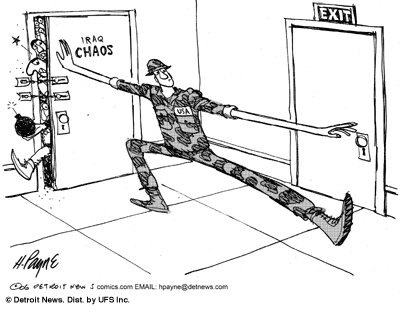
I am an unapologetic leftist. The war was immoral; it was waged on the pretext of a lie and has no clear objective. Without an objective there is no means by which “victory” can be measured or defeat determined. What I find most disturbing is that I see no way out that will not inflict more damage than we have already done. We created a civil war. Hussein may well have been a tyrant, but we have become an army of invasion short of occupation. Our nation has become a latter-day pirate, raiding a nation on the pretext of a lie with no interest beyond lip-service for the well-being of the people whose country has been destroyed.
 Cut and Run
I have to concede that the neo-fascists in our nation have won the war of rhetoric. By creating a false dichotomy they have defined the debate to serve their own propagandistic needs: loyal opposition to the war becomes an act of cowardice and any dissent is couched as non-support of “our brave boys in uniform”. The Democratic Party, traditionally a war party, has done poorly in meeting the debate. Leadership by polls is not leadership: somebody has to have the courage to say “No” to the lies that have been told and to challenge the denegation of civil rights in the name on the “War on Terror” and to stand and say it take courage to fix what cowards have destroyed.
I do not believe that there is an easy way out of Iraq. To leave now is to leave a country destroyed. George Marshall – hardly a liberal – understood the need to rebuild Germany following World War II. It was not for the sake of generosity or kindness, but because it was in our national interest to do so. The reality is that doing good helps us to do well. So what is the good that needs to be done in Iraq? We have to admit that we have destabilized a nation by generations of manipulation of the region. Iraq became our friend when Iran became our enemy. We were happy to have the tension between both nations because that polarized their attention. Our CIA put Hussein into power. We are ultimately responsible for his having been put there, much the same way that we are the authors of Agusto Pinochet’s ascension in Chile. We went to Iraq for oil. We have blood on our hands.
Sadly the rhetoric has become the reality. Leaving Iraq now leaves the country embroiled in a civil war that has no certain outcome. It allows for flux that will be inherently destabilizing. We need to leave, but it has to be an orderly withdrawal that places the United Nations in the role of peacekeeper and arbitrator to avoid further deterioration in the region. Beyond this, we have to wean ourselves from our dependence upon oil. The reason that we find ourselves in such a mess is that this nation has reserves that are environmentally sensitive. We are the proverbial NIMBYs: Not In My Back Yard. We will not destroy our land and natural beauty, but are content to destroy a nation to feed our dependence on petrol-chemicals.
Changes at the Root
The word “radical” derives from the Latin word radix which means “root”. At the root of the issue is the essential instability that this addiction creates for our nation. It is in our national interest to use the great power of industry and government to create new sources of energy that are both green and available to all. This is not science fiction, it is a matter of will. Do we have the will to undergo a period of painful transformation to give birth to a new future that creates new markets and employment, allows us to be secure, and to diminish the power that the region holds to blackmail our nation with oil?
This is a bet that I would suggest we take. Hell, we’ll even double down.
Ah, but I am only a fool…
December 11, 2006
The Seven Deadly Sins
Following my last post – I should never write and publish when I am struggling to sleep; nonsense is the result, and not even my usual caliber of pontification or criticism at that – I thought to take some time and actually write, much as I used to do. Anybody that knows me also knows that I have had a virulent dislike for the holiday season. Partially because of the consumerist frenzy, partially because I become depressed, partially because I am loathe to celebrate simply because I am told, “tis the season to be jolly…” All of that seems rather contrived to me. Call be acerbic, cynical, or anything else that you may find in your lexicon; the truth is that I have little use for the holidays.
Apropos my dislike of holidays, I was given pause to consider the seven deadly sins. Most of us have heard of them, most of us are participants in these, and their opposing virtues as well – simil iustus et peccattor, I suppose – but I would equally suppose that such a listing of virtues and vices runs contrary to a culture that thrives on excess, hedonism, and egocentrism. I am not immune from this, indeed, count the occurrences of the pronoun “I” and one can quickly extrapolate that my universe may not me solipsistic, but it is certainly egocentric. At any rate, here are the seven deadly sins and a brief description of their characteristics (taken from www.deadlysins.com):
The truth is that all of these are exercises in excess and that they are all interconnected. One cannot be involved with one without encountering another. We all share these traits, we all, to a greater or lesser degree, find ourselves involved in them. There are no fingers pointing. This is the reality of life. Think about lust for a moment. It is born of greed and involves envy and or gluttony. Sloth, laziness – sadly, my favorite of the sins – has to do with avoiding spiritual or physical work. We dwell in a consumerist haze that blinds us to spiritual development (more later on that issue) and leads us into a fool’s paradise of new-age nonsense or, worse, a diluted embrace of an “Idiot’s Guide” version of a given religious tradition. Think about a person tattooing Hebrew letters onto his or her body to celebrate their Judaism when that selfsame religion forbids tattoos. That is like eating pork to celebrate Islam or, worse, thinking that it is OK to eat faux port to enjoy that “great pork flavor” without actually eating the flesh of the swine. What happened to the greater meaning of the command? It becomes overly literal or impotent and merely metaphorical.
The Greatest Possible Good
I have to confess that I have left theological ethics as a relic of antique religious confession. I find that the art of living in community requires that humans transcend our basic greed and adopt a functional morality that values the “happiness” of the greatest number as its driving principle. By “happiness” I do not mean contentedness or even satisfaction with a person, place, or thing: I rather think of a meeting of life’s needs that the person is free to live in a world that is marked by clean air and water, available food and shelter, freedom to pursue interests and freedom from poverty. This is a culture or society predicated on the greatest good for the greatest number. There is no need of God in this equation, though many may find expressions of the divine in this: “to have done this for the least of these is to have done this for me” are the words attributed to Jesus of Nazareth.
Happiness is not the fulfillment of desire. Indeed, this is the realm of the construct that we call the Seven Deadly Sins. Pandering to desire, to the passions of the self, drive systems of oppression such as capitalism and lead to violent confrontation. It is an issue of balance, an art to life in community that has to constitute the basis for any moral system that can be ecumenical, secular, and regard an individual or culture’s spiritual moorings. The irony is that pandering to desire leads to greater dissatisfaction and ultimately to despair. This is most evident when one considers the spiritual emptiness of the so-called developed world: we are rich in things and poor in soul. We try to find satisfaction in sex, in excess, in food, in making ourselves into more or less than we are. We are guilty of sin; we have forgotten that we are stardust that has had the good fortune of having become animate and sentient.
Creation Myths and Connection
I am most familiar with the Christian telling of the Jewish creation story. This myth is powerful indeed and seeks to convince us that we share a common origin and destiny: we are dust and to dust we shall return, as the Ash Wednesday Liturgy has it. From our beginnings and in our ends we are dependant upon others. To believe that we are not is to deny our connection to a community that gives us myth, language, means of expression of our thoughts and articulation of our needs. It also reminds us that we are of no ultimate importance in and of ourselves. Dust has not real importance. Neither do the constructs of dust. What is money but a metaphor for wealth that is not real in any absolute sense of the word? Gold is valuable because it is agreed upon as a value. It is nothing apart from that. The only things that we truly need are food, shelter, and tasks to occupy our minds and body.
Pride: we believe that we are more than dust. The question of whether God exists or not is irrelevant to the question: it is what we will do with the reality of our finitude and ultimate disintegration that matters in this moment. The truth is that we are nothing. So why not enjoy the ride? Take what you need, use what you take. Be kind because kindness allows us to live in harmony with one another and serves not only the greater good but “my” good and is in “my self-interest.”
The curious thing is that the Seven Deadly Sins deal not in proscription, but in excess; they counsel moderation that allows enjoyment of life. The exception to this is Pride. It is not that Pride disallows God, but that Pride denies origin and destiny thus making authentic life impossible. If I am free from myself, I am free for other things that allow a greater joy and happiness than I could otherwise enjoy. Just a few thoughts over the holidays… More on that later.
- tDF
OK, Just for Fun I did the quiz to see my favorite sins... No surprises here! -tDF
Take the Seven
Deadly Sins Quiz
Apropos my dislike of holidays, I was given pause to consider the seven deadly sins. Most of us have heard of them, most of us are participants in these, and their opposing virtues as well – simil iustus et peccattor, I suppose – but I would equally suppose that such a listing of virtues and vices runs contrary to a culture that thrives on excess, hedonism, and egocentrism. I am not immune from this, indeed, count the occurrences of the pronoun “I” and one can quickly extrapolate that my universe may not me solipsistic, but it is certainly egocentric. At any rate, here are the seven deadly sins and a brief description of their characteristics (taken from www.deadlysins.com):
- Pride is excessive belief in one's own abilities that interferes with the individual's recognition of the grace of God. It has been called the sin from which all others arise. Pride is also known as Vanity.
- Envy is the desire for others' traits, status, abilities, or situation.
- Lust is an inordinate craving for the pleasures of the body.
- Anger is manifested in the individual who spurns love and opts instead for fury. It is also known as Wrath.
- Greed is the desire for material wealth or gain, ignoring the realm of the spiritual. It is also called Avarice or Covetousness.
- Sloth is the avoidance of physical or spiritual work.
The truth is that all of these are exercises in excess and that they are all interconnected. One cannot be involved with one without encountering another. We all share these traits, we all, to a greater or lesser degree, find ourselves involved in them. There are no fingers pointing. This is the reality of life. Think about lust for a moment. It is born of greed and involves envy and or gluttony. Sloth, laziness – sadly, my favorite of the sins – has to do with avoiding spiritual or physical work. We dwell in a consumerist haze that blinds us to spiritual development (more later on that issue) and leads us into a fool’s paradise of new-age nonsense or, worse, a diluted embrace of an “Idiot’s Guide” version of a given religious tradition. Think about a person tattooing Hebrew letters onto his or her body to celebrate their Judaism when that selfsame religion forbids tattoos. That is like eating pork to celebrate Islam or, worse, thinking that it is OK to eat faux port to enjoy that “great pork flavor” without actually eating the flesh of the swine. What happened to the greater meaning of the command? It becomes overly literal or impotent and merely metaphorical.
The Greatest Possible Good
I have to confess that I have left theological ethics as a relic of antique religious confession. I find that the art of living in community requires that humans transcend our basic greed and adopt a functional morality that values the “happiness” of the greatest number as its driving principle. By “happiness” I do not mean contentedness or even satisfaction with a person, place, or thing: I rather think of a meeting of life’s needs that the person is free to live in a world that is marked by clean air and water, available food and shelter, freedom to pursue interests and freedom from poverty. This is a culture or society predicated on the greatest good for the greatest number. There is no need of God in this equation, though many may find expressions of the divine in this: “to have done this for the least of these is to have done this for me” are the words attributed to Jesus of Nazareth.
Happiness is not the fulfillment of desire. Indeed, this is the realm of the construct that we call the Seven Deadly Sins. Pandering to desire, to the passions of the self, drive systems of oppression such as capitalism and lead to violent confrontation. It is an issue of balance, an art to life in community that has to constitute the basis for any moral system that can be ecumenical, secular, and regard an individual or culture’s spiritual moorings. The irony is that pandering to desire leads to greater dissatisfaction and ultimately to despair. This is most evident when one considers the spiritual emptiness of the so-called developed world: we are rich in things and poor in soul. We try to find satisfaction in sex, in excess, in food, in making ourselves into more or less than we are. We are guilty of sin; we have forgotten that we are stardust that has had the good fortune of having become animate and sentient.
Creation Myths and Connection
I am most familiar with the Christian telling of the Jewish creation story. This myth is powerful indeed and seeks to convince us that we share a common origin and destiny: we are dust and to dust we shall return, as the Ash Wednesday Liturgy has it. From our beginnings and in our ends we are dependant upon others. To believe that we are not is to deny our connection to a community that gives us myth, language, means of expression of our thoughts and articulation of our needs. It also reminds us that we are of no ultimate importance in and of ourselves. Dust has not real importance. Neither do the constructs of dust. What is money but a metaphor for wealth that is not real in any absolute sense of the word? Gold is valuable because it is agreed upon as a value. It is nothing apart from that. The only things that we truly need are food, shelter, and tasks to occupy our minds and body.
Pride: we believe that we are more than dust. The question of whether God exists or not is irrelevant to the question: it is what we will do with the reality of our finitude and ultimate disintegration that matters in this moment. The truth is that we are nothing. So why not enjoy the ride? Take what you need, use what you take. Be kind because kindness allows us to live in harmony with one another and serves not only the greater good but “my” good and is in “my self-interest.”
The curious thing is that the Seven Deadly Sins deal not in proscription, but in excess; they counsel moderation that allows enjoyment of life. The exception to this is Pride. It is not that Pride disallows God, but that Pride denies origin and destiny thus making authentic life impossible. If I am free from myself, I am free for other things that allow a greater joy and happiness than I could otherwise enjoy. Just a few thoughts over the holidays… More on that later.
- tDF
OK, Just for Fun I did the quiz to see my favorite sins... No surprises here! -tDF
| Greed: | High | |
| Gluttony: | Medium | |
| Wrath: | Low | |
| Sloth: | High | |
| Envy: | High | |
| Lust: | Very High | |
| Pride: | Low |
Take the Seven
Deadly Sins Quiz
December 08, 2006
insomnia
that your mind races like a formula one in some European classic and it continues to accelerate spinning beyond the redline fueling the need for rest but disallowing the reality of rest so I sit here like a condemned man awaiting his fate the green room having been prepared and time which normally is fleet and winged seems to have come to a standstill as I await a rest penultimate though it may be that seems to be longstanding and distant like Tantalus standing chin deep in sweet fresh water with beautiful fruit only an inch from his fingers both drawing away as he nears them to satiate his needs and appetites but only tormented by their proximity and distance ironic that there is something of a brutal irony in the fact that I am sitting typing and cannot find a moment to rest my mind is rushing racing like an Indy car over Memorial Day thoughts rushing and saying precious little worth thinking much like the news of the past several days much like listening to our president stating that if we don’t pull out of Iraq we will not be victorious much like his response to the bipartisan report suggesting that his adventurism as only cost the lives of too many combatants and innocents leaving a blood trail a stain of guilt and a metaphor for our insatiable appetites for petrochemicals and yet I am loathe to admit that I would not even be typing were it not for plastics and energy produced at the cost of the environment is that an irony or an act of hypocrisy I don’t know the church called this a double-bind original sin that is damned if you do and damned if you don’t if I am equally damned then fuck it I’ll have a good time but at what cost I was thinking about the past a few days ago dazed and confused fucking my way though an office having become something of a joke an initiation rite for new female employees of a certain age it really did not matter how many women I did at that time don’t you hate that expression as if a person is simply something not someone that is done do me cream me fuck me oh fuck me for having been such an ass during those days truth is that I didn’t have sex with half the women that my reputation might have suggested but I was a kid in a candy store in a diabetic coma in a stupor induced by excess and my mind continues bush is an ass that has no idea what the hell is his doing in Iraq and does not seem to appreciate that we this nation are the cause of terror why do they hate us because we destroyed the order of the world a novo ordo secularum that is vastly inferior to the clear and present oppression that we are ghost writers to we put Hussein into power we put the Shah into power we have been playing poker with smaller countries as part of our chess match with Communism checkmate but the bluff still goes on like Texas hold’em the river has been dealt and we are still playing the cards without regard for the man the cat is crying at my feet he chased me out of the bedroom and attacked by foot as I walked past he is a good puss cat like women you never know what makes them happy but sure as hell can tell when they are pissed I love women but do not understand them but that is part of the charm I admire and adore women but cannot claim to understand them I walked into the coffee room at my former workplace one day and overheard a conversation between two women one that had slept with me the previous week and another that had not who said that she wanted to fuck me I walked in when she said this and could only reply and so you shall my dear but never did no I never did morality confuses me why is sex a bad thing but killing on a massive scale makes for statesmanship unless you are on the wrong side of the battle in which case it becomes a war crime it seems that the whole dilemma is somewhat relative there are no absolutes left in this world Christmas is coming the goose is getting fat bad for the heart I really hate the true spirit of the holiday who really cares that it is an arbitrary declaration of the early Christian church in response to Saturnalia to have a child born of a virgin another ironic statement chastity in the face of accusations of harlotry I don’t grasp the contradictions of the Christian faith which I used to profess and now have regressed to a gentile agnosticism that is disinterested in the question because it is difficult for me to find relevance in the whole issue of God I hate insomnia the problem is
October 31, 2006
Cause and Effect
I have never been a proponent of the idea that there is always a clearly defined and discernable cause and effect for any event, action, and so on. Too many variables, known and unknown, tend to cloud the calculus to trust the results absolutely. I believe in chaos, albeit a limited chaos – similarly, I believe in finite freedom of the will but that is an arcane theological issue concerning eschatology and faith – that clouds the judgment and disallows a purely empirical assessment of primal cause and ultimate effect.
Science is largely built on logical detached observation: its central article of faith is (relatively) objective observation. Heisenburg drilled holes in that supposition when he noted that the presence of an observer changes the experiment. What we know we have either reasoned out by having criticized the observation and established the relative predictability of a result to a given action. Ultimately, however, we don’t know. We trust in experience and in the maxims that describe the experience of others that have made similar observation. Our experience, while not absolute, allows existential certainty that a predictable result will follow a known cause. I let go of an object and it will fall toward earth: gravitation is observed and works. One might argue that the elemental forces of nature are immutable, perhaps even absolute. One might be correct in the assertion that an object dropped will always fall in the presence of gravity, or even that both objects will move toward each other in a manner that reflects the mass of either. But one cannot absolutely prove this, whether for fault of language or experience the possibility remains that it may not be so, however infinitesimal that possibility may be.
The human heart is a whole other thing. It has a logic all its own that defies simple cause/effect relationships. Why should this be? Are not our emotions the results of a physiological response to a stimulus? I hear a phrase or see an event. My brain processes that event and responds, based on its programming: the sum of my experience and the value system inculcated into that heart and mind. I hear that my wife wants a divorce and my heart breaks, as it has on two occasions. My daughter tells me she loves me and I feel a “warmth” that is simply ineffable. A car cuts across my path while cycling – as happened today – and I feel anxiety followed by relief. These are predictable. It is the events of the heart and mind that defy prediction which are difficult.
This brings me to my real concern today. I remain confused by the depth of emotion that I feel and the way that this seems only to intensify as I grow closer to 50 years of age. Jung once postulated that NTs (intuitive thinkers) become more feeling and sense oriented as they age, as if the psyche is seeking a balance. The same is true for other types, SJs (sensing judgers) become more imaginative and willing to let things be open, and so on. This is difficult for me as I am painfully aware that emotions pass, but the havoc that they can create remains long after the feelings have dissipated into the mist.
As an NT, I have always looked for order, even an order that is predicated upon chaos – I am intuitive, my mind can be wrapped around that idea – and I fear that this has been a quest that will never be completed. There is a part of me that has always felt that it is the journey, not the destination that causes the sailor to cast of the dock-lines. I have never felt that there is an ultimate meaning to life – Westminister Catechism be damned – and that we are not blessed with the vision to see beyond the context of our lives. Thus, all observations are by their nature narrow and parochial, subject to revision and in need of constant correction, or not ( I have to leave that possibility open, if I am to be an honest fool).
The problem with any strong emotion is that once it is past you are left with results that you could not have predicted because the chaos of the human heart and mind is greater than the ability to reason forces of nature.
Ah, but I am only a fool…
October 27, 2006
The Great Wall of Bush
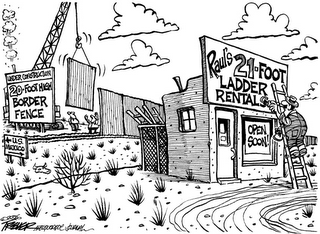
Have you ever heard the old joke about Mexican Olympic atheletes? Why has Mexico never won a gold metal in the summer games? Because any of us that can run, swim, or jump are already here! I can tell that joke, being Mexican. A white guy tells it and it becomes racist. Double standards... I doubt that we will ever outgrow them. Speaking of double standards, here it the summary of a bill signed today by "W" proposing that we partition the southern border of these United States.
And my longstanding question remains... how many hungry children could be fed with $2,000,000,000? Are strawberrys and inexpensive labor for jobs that we really don't want to do anyway presenting that much of a risk to National Security? To tell you the truth, were I to enter the United States for nefarious purposes, I'd cross at Niagra Falls. If I were trying to do so clandestinely I might drop myself offshore and enter on either coast.
But we'll have our own fence...
But I am only a fool...
109th CONGRESS
1st Session
H. R. 4083
To direct the
Secretary of Homeland Security to construct a fence along the southern border of
the United States.
IN THE HOUSE OF REPRESENTATIVES
October 19, 2005
Mr. GOODE (for himself, Mr. HUNTER, Mr. GINGREY, Mr. HAYWORTH, Mr. ROGERS of Alabama, Ms. FOXX, Mr. BARRETT of South Carolina, Mr. JONES of North Carolina, Mr. GARRETT of New Jersey, Mr. TANCREDO, Mr. NORWOOD, Mr. DEAL of Georgia, Mr. DAVIS of Kentucky, Mr. SULLIVAN, Mr. BROWN of South Carolina, Mr. WILSON of South Carolina, Mr. SAM JOHNSON of Texas, Mr. CULBERSON, Mr. POE, Mr. CARTER, Mr. ROHRABACHER, Mr. RADANOVICH, Mr. HOSTETTLER, Mr. SESSIONS, and Mr. KING of Iowa) introduced the following bill; which was referred to the Committee on Homeland Security
A BILL
To direct the Secretary of Homeland Security to construct
a fence along the southern border of the United States.
Be it enacted by the Senate and House of Representatives of the United States of America in Congress
assembled,
SECTION 1. SHORT TITLE.
This Act may be cited as the `Border Security Improvement Act'.
SEC. 2. CONSTRUCTION OF FENCE ON SOUTHERN BORDER.
Section 102 of the Illegal Immigration Reform and Immigrant Responsibility Act of 1996 (8 U.S.C. 1103 note) is amended--
(1) by striking `Attorney General' each place such term appears and inserting `Secretary of Homeland Security';
(2) by redesignating subsections (c) and (d) as subsections (d) and (e), respectively;
(3) in subsection (b), by striking `subsection (d)),' and inserting `subsection (e)),'; and
(4) by inserting after subsection (b) the following:`(c) Construction of Fence on Southern Border-
`(1) IN GENERAL- In carrying out subsection (a), the Secretary of Homeland Security shall provide for the construction of a fence along the entire southern border of the United States.
`(2) AUTHORIZATION OF APPROPRIATIONS- There are authorized to be appropriated $2,000,000,000 to carry out paragraph (1).'.
But we'll have our own fence...
But I am only a fool...
October 13, 2006
What Can One Person Do?
It feels self-indulgent to be writing about weight loss when the world has decided to take itself to hell in a hand basket. Anybody that knows me knows that my mind is generally working on more than one level. I think in terms of both the macrocosm and microcosm. All things in an organic system are tied together in a cause-effect relationship. Think about it: cancer begins as one cell. Healing can begin with one person. No, I am no megalomaniac: I have a healthy ego, but it is not that swelled. I believe that we are more powerful than we believe.
There are two basic mistakes that one can make cycling. Pick too big a gear, pick too small a gear. Put more plainly it is to overestimate or underestimate ability, capacity, resources, and so on. I’ve made the same errors riding. Pull too small a gear on a hill and your legs spin out, pull too big a gear and your legs burn out. I’ve done this as recently as miles 60-70 on the last century I rode. What I needed to know is realistically what I could do. I needed to know what I could and could not do. I needed to know my strengths and my weaknesses.
So what does this have to do with the systematic dismantling of civil liberties, the harm that the current administration is doing to the environment, the disparity between the rich and the poor? It means that I have incredible power to effect change. So do you. The greatest error is not to risk the life-change that is required to make change. It is a funny thing: The only way that I learned my limitations was to force myself to my physical resources end. I was so damn tired that I could hardly stand. I wondered, when was the last time I was so damn tired from the struggle for peace and justice that I could hardly stand. There was a time that I was not only an endurance athlete, but deeply involved in the struggle to make the world a better place by making my little corner into a better place altogether.
Once cell can begin a cancer that leads to the death of the organism; one person can begin the change that heals the world. I have an errand to run. I’ll take my bike rather than driving and save a bit of gas, get some exercise, and – almost as a side effect – do that small bit to heal the planet. It may be just a bit, but great things are made of such small bits.
Ah, but I am only a fool…
October 12, 2006
One Hundred and Two Miles

There are times that a goal which is distance needs to have milestones, way-markers that allow a person to see progress toward a goal that is too distant to comprehend. For me, losing nearly sixty pounds is a goal that is too large to comprehend. Just losing weight can be easily accomplished. But that is really not the goal. The goal is good physical health. That means a change in lifestyle. Food, my favorite vice, needs to be seen differently. I can’t use food as comfort. I can enjoy my food, but I cannot become a glutton. Equally the word “exercise” had fallen out of my lexicon. It has to become part of lifestyle.
So, to make an attainable goal I decided to ride a century. That is one-hundred miles on my little bike. I did it, with a caveat. I rode over 100 miles, but did not complete the course. I took a wrong turn that resulted in my taking about 20 miles more than I should have before the second to last rest-stop. I found the second to last and realized that I should have been at 65 miles and was at 87. That would mean that I would ride over twenty miles over the distance of the century plus the 15 mile round trip to and from the staging area. I decided to use the SAG vehicle for the last part of the ride. Now, my 87 plus 15 was 102 miles. It was a century, but not the century that was defined.

I am doing it again in February. I made several mistakes on this ride. The Harvest Ride for Literacy was a course marked by serious hills (Category 1 Climbs: >5% grade for 6-12 miles). This was not a good “first century”. The worst of the hills were between miles 60 and 70. They really knocked the wind out of my sails. I truly believe that I could have finished the course, but would still be recovering from the physical stress placed on my body. I under-trained, especially on hills. In the past I was an excellent climber. At 6’1” and 185 pounds I could leg-press 650 to 700 pounds, on a bet I once got 800 pounds up (and never want to do that again!). Needless to say, hills were not an issue. I did serious weight work to get that power in my gams. Now I am not in a gym but am wondering about running and jump-rope.
What is the point of all of this athletic nonsense? It has to do with discipline to make a change in life. I am committed to this change, as I am to others. Riding a century is a metaphor for other achievement. Do you know how to ride a century? It is really simple. Get on the bike and turn the pedals for 100 miles, approximately 31,875 times at 85 rpm.
Ah, but I am only a more toned and thinner – 228 pounds! – fool!
September 24, 2006
A Thicker Fool than I Like
There is comfort on my couch. It never says “no” to me and is always there to welcome me like a lost and well-loved friend would. It never judges me, but instead accepts me just as I am, or – more honestly – as I have allowed myself to become. My couch is my most enabling friend: my couch contributed to my allowing my once athletic frame to have become more than ample. I learned that, according to any definition, that I am obese. Obese. Obesity is something that this former endurance athlete could never in his wildest dreams have imagined as a fair description of himself. I have difficulty using the word in the first person. Here it is: I had become obese.
At my worst I weighed 245 pounds. I am six foot, one inch with a moderate frame. I should weigh 190 pounds to be on the high side of healthy. I was carrying 55 pounds more than I should have. Just to put that into perspective, to lose one pound of weight a body has to burn 3500 calories beyond what is necessary to take in to maintain life. To get to my healthy target, 188 pounds, I would have to burn 1,995,000 calories. [See correction below] Now, what causes me shame is this statistic: to maintain life, a person can do well on about 2000 calories per day. The calories that have gone into making me obese could have fed a person for 997.5 days. This is nourishment lost to a hungry world. The calories that must be burnt to lose my middle-age paunch could have sustained another for 2.7 years.
Here is another way to look at it: I love MacDonald’s Sausage Mac Muffins. They have 370 calories in each. The weight that I have put on is equivalent to 5,391 of these sandwiches, nibbling a bit on number 5,392. Now, what does a sausage Mac Muffin cost? I would tend to buy these when they were on sale two for $3.00. That is $8,088.00 in calories that just hang over my beltline and shorten my life. No, I am not blaming MacDonald’s. There is only one person ultimately responsible for my choices: Mea maxima culpa.
I’ve thought about this much. We use the image of obesity as a metaphor for our country’s hunger for oil. Yes, this needs to be changed. We need to wean ourselves from our gluttony for resources that harm our environment and create a gross disparity between rich and poor. But I have to start with me and my gluttony, for oil, for my little snacks, for all of these things that are comforting but ultimately deadly. Long term changes mean a change in life. These are more easily imagined than accomplished. It is one thing to have a lofty goal and quite another to be about the mundane activities that bring the goal to fruition. The difficulty is that milestones, way-markers, and accomplishment are measured not by one sudden explosion of accomplishment, but in imperceptibly small increments. Trend lines may waver, but the trend is what is important. Motion toward is the prolegomena to having crossed the line. I have decided to change my way of life to be healthy in all facets of life. I have made tentative steps in these directions and have retreated into the comfort in my less than salubrious lifestyle.
My couch is still my friend, but I have another friend that has been helpful to me, as well: My road-bike. I have lost 13 pounds toward my goal of 55. It is a start, a modest one, but it is a beginning. I am trying to ride at least 150 miles per week and have entered a Century, the Tour for Literacy (money raised goes toward local literacy efforts). I am still leaning how to eat less and how to find other means of comfort than my couch and snacks. There is no quick solution. I have begun to wonder how I can raise $8,000 or so for local hunger projects (that seems fair to replace what I consumed), but that is still in the dreaming stages.
Changes come, but they come in very small steps. And my couch still welcomes a slimmer frame, eating celery instead of cheese.
Ah, but I am only a fool...
Correction to the previous post: This proves that I am a better wordsmith than accountant! There is a gross error of addition in the above posting.
- To lose one pound, a person has to burn 3500 calories beyond what is necessary to maintain current weight. In my case, I have to take in about 3600 calories per day to maintain my current weight. To lose about two pounds per week I have to burn at least 500 calories in exercise and cut out at least 500 calories in meals. So far so good...
- Now to the error of fact... I was 57 pounds overweight. 57(3500) equals 199,500, not 1,995,000 as I noted!
- So... 19950/370 calories in each Egg McMuffin equals 539 of the luscious atery cloggers, not the 5000+ that I noted. Still, that's lots of money for fat: $808.78.
- Now... The calories that I have to lose could sustain a starving person for 100 days, not 2.7 years.
My errors in addition aside, the point remains... We have way too much and others have way too little. Maybe there is a realistic way to raise $1000.00 for local hunger. - tDF
September 14, 2006
The Fool is Back
The silence is broken, for better or worse.
For better or worse, the fool is back.
March 22, 2006
I Love Questionnaires
My Name: Pablo
Childhood Ambition: To be a studio musician or a rider in the Tour de France; I also recall dreaming about singlehanding a Luders 30 around the world.
Soundtrack: Whatever I am listening to at the moment… too much good music to limit myself to one type. If I had to select one type of music it would be either Jazz (Bebop or Free Jazz), Seventies Rock, Blues, or the Beatles.
Retreat: My mind. Wherever I am, I can take refuge in my strong imagination. Sometimes, though, it is hard to come out. I can become very insular, even passive. The downside is that my mind and inner world can become as sheltered as a tomb. That is the problem; it becomes a terminal rest, passivity is the hallmark of death.
Wildest Dream: This is where I cease to be ironic and become simply contradictory! My wildest dream is to be more proactive, less passive and to find the passion that used to drive me.
Proudest Moment: My proudest moment was when I first looked at my daughter, R, when she was born. There she was, a perfect little person that I swore to love beyond all things. She is my love and life. So is A, my younger daughter.
Biggest Challenge: Life
Perfect Day: Has eluded me.
First Job: Clean up boy at Galletti’s Fine Meats. I learned about beautiful food there, all the while cleaning up an Italian Butcher Shop.
Indulgence: Maybe my problem is that I don’t indulge myself!
Last Purchase: Here is a thriller: Kitty litter and two mice for Cuddles (my snake).
Favorite Movie: It would be a tie between
Inspiration: To be a man worthy of my children’s love.
My life: is improvised well beyond the changes played.
March 16, 2006
DSL Has Been Down
I'm writing from my desk at school. My DSL has been down and I have not been able to post for the past several weeks. I never realized how much I've come to depend on the interenet for everything: work, fun, bills, research. Not having access to the web has been like having an arm incapacitated: I miss reading blogs, playing my games, listening to music, and so on. I have been tied to my desk because I cannot access information from a remote site. Worst of all is not being able to access email. This is supposed to be resolved today, and I am looking forward to reconnection. It has been "iffy" since the end of January. I miss my DSL.
February 25, 2006
Treasure in Earthen Vessles?
I was a Lutheran Pastor for nearly twenty years. I have several years of advanced theological training. I feel competent in making a critique of what often passes as the Christian faith. I do not pretend to speak for any denomination. My thoughts are mine alone.
Personal Salvation?
I am disturbed by the idea that the event of the Christ was simply to effect personal salvation. It would be ignorant to dismiss the centrality of the incarnation in Christian theology; indeed,
What is the eschatological imperative? It is to be Christ for the world. I am not speaking the double-talk of the new age self-justification. To my mind, this is spiritual masturbation: so much self-pleasure with no love or intention of sharing community. To be Christ for the world is to lose one’s self for the sake of the world. This is what the myth of the incarnation of the logos bespeaks: God comes into the world to be broken by the sin – becoming the curse – that even the deepest fractures of the human heart may be healed by the brokenness of the Christ. As Christ is raised, so to shall humanity be raised in the likeness of the Christ. It is significant that the risen Christ still bears the prints of the nails: the wounds did not heal; they remain as Christ returns to bear the brokenness of humanity to the perfection that is God. This act perfects God and gives birth to hope where once there was despair. Why, then, do we speak of personal salvation? Look at the myths of the fall. Our individual parents were cast out of the garden, out of a place of harmony and peace. Individuals must be welcomed back to the garden if they are to live lives that are not bound up in their lust for their own welfare.
Lust for Self-Preservation
Gandhi was a rather pointed critic of the Christian religion: “Oh, I don't reject your Christ. I love your Christ. It's just that so many of you Christians are so unlike your Christ." I do not believe that Gandhi is the ultimate arbitrator of the truth of Christianity. I do believe that it is a fair critique of the practice of the faith in Western Culture. The Christian religion is not a doctrinal system as much a covenant between God and humanity, a promise made between the lover and the beloved.
The crux of the faith is to be free from the need to be saved. If I am free from myself, I am free to be love for others, especially for the unloved.
This is the key article of the doctrine of the incarnation: God transcends God’s self to be for humanity. In this way, the individual is freed from self-preservation to be for the other. Sadly, this has not been the case for most of the history of the Christian faith. Much of the faith becomes an article of self-justification and thus a sullen caricature of itself.
God is Love
I have, for years, been haunted by a small – only five short chapters worth – epistle in the NT, First John. In this short letter the author, an anonymous writer influenced by
The difficulty with truth is that once you have encountered it you are changed. You can no longer claim ignorance and are now held hostage by its demand to change.
I believe this is why most Christians have degraded the depth of their creed and have settled for a lesser eschatology; another word for this is original sin. We have made God over in our own image; we have made God into a source for my eternal life without considering the depth of love that drove the eternal to embrace the now. Consider that most Christian evangelism says nothing of a duty in love to care for the needs of all flesh. If God is love, and we are the disciples of the Christ, how, then, can we stand apart from this demand to love all? This terrible truth means death, not eternal life.
Justification by Grace through Faith
God justifies, that is God puts us right. We are free from the need to be for ourselves. Faith, then, is the act of living as if we are free. It is the strong word of God that says no to all that would imprison us, including wealth and self-satisfaction. That I would have criticized the so-called theologians of liberation for their confusion of ethics and eschatology. Now I am not so certain that this is a valid critique. I do not believe that we are the force that brings the
This is why I am not a Christian. I love the Christian myth, but feel that this is beyond me. I believe, help my unbelief. I think that too much dilution has taken place. We have lost ourselves in a sea of things and self-satisfaction, on both the materialistic and metaphysical levels. Perhaps Gandhi was right: there are precious few Christians. Prayer has to be transformed into action. Creed has to find articulation in life. Poetry has to become the muse that inspires life, like YHWH playing with the dust, forming it into a body and inbreathing life and then declaring love for the dirt that had infinitely greater potential than dirt could imagine. It became the dwelling place of the logos. Perhaps it is a treasure in an earthen vessel?
February 21, 2006
From It to Thou - Part 2
Beyond the First Person Singular
Forgive the awkward grammatical image: What has hurt us and has created us is the drive to assert “my” right to live over and against “your” right. Buber would have called this an “I/It” relationship. The other is a means to an end, an obstacle to overcome. Think about the epithets of warfare. The enemy is never thought of as human. The enemy is a “gook,” “heretic,” “nigger,” “fag,” and so on. The uglier the epithet, the greater the fear. Really, what have to fear in each other? Why do we need to be the greatest at the expense of the other? I would suggest it is our fear of extinction that drives the engine of hatred.
So Why Are We So Afraid?
I am amazed at the cost of warfare; finances aside – money has no value except that which we have assigned to it – the real cost of warfare is in lives lost. There is precious little that is worth anything: We have time and our life, nothing more. We use resources and leave a legacy of consumption in our wake. We cling to life with terrible tenacity, but will as quickly dispose of life. What has struck such fear in our hearts? Why are we so afraid?
I think that it is part of our evolutionary imprinting that has made us into creatures defined by competition. We are accustomed to the struggle. We long for the bitterness of victory and defeat. Life devolves into a win/lose dichotomy. Competition, from my limited perspective, bespeaks fear. We compete because we are afraid of loss. I do not accept the notion that competition drives progress. That makes for good capitalism, as it implies a profit and loss equation: somebody wins; somebody else loses. The cycle is not ascending: it is circular. Times and names have changed. The periphery has been altered, but the essential equation of hunter and hunted remains. We remain in fear of a perceived enemy that shares more in common with us than we dare to imagine. In a real sense, we are afraid of ourselves. The mirror frightens us.
Is Conflict the Only Impetus to Evolution?
Conflict has, without a doubt, created intelligence. Consider the predator: predatory animals must be intelligent. They have to rely not only on the weapons at their disposal, but an innate intelligence that allows them to hunt, capture, and consume their prey. The idea of a food-chain has driven evolution, especially human evolution. We developed from a simple ape that began to develop tools, later developing a brain that allowed the creation of theology, art, philosophy. But is this the only impetus?
I posit that the next evolutionary development is one that moves beyond confrontation with our fear. The ultimate fear is of our own finitude. We face the immensity of a universe that is both infinite and infinitesimal and find that we occupy a very small bit of space and time. We are momentary expressions of life that possess self-awareness. To overcome our fear of finitude is to accept the reality of our own extinction. This is not an issue of God. It is an issue of acceptance of a godless universe that is beyond our comprehension.
God, Religion, and the Spirit
It is almost an excurses that is necessitated: it is not that I do not believe in God, I do not believe in the God that is the necessary parent for lost and fearful children. There are moments when even the most courageous of us requires a moment of spiritual comfort. This having been said, I do not believe that a world come of age – to borrow a phrase from Dietrich Bonhoeffer – requires a God that is there to hold humanity’s hand as it crosses the street. What God, then, do we worship in a godless universe? I believe in God as the ultimate source of all life and as the connection that holds us in a community that exists in space/time. I find great beauty in the myth of the incarnation: a God that transcends the eternal glory to experience the finitude of the creation (using that term advisedly). This is the God that seeks to lead by experience of the most deeply seeded human fears. This embrace of our fear allows God to be the God that both is and exists. A humanity that has come of age requires a myth that allows us to face the darkness as adults.
God becomes human. The eternal become finite. Our minds allow us to imagine an infinity and beyond (apologies to Georg Cantor) and in so doing suggests that we, at least in the realm of imagination – intuition? – move beyond what is merely sensed and can only be spoken of as metaphor. The human mind embraces the infinite and infinitesimal. In so doing it embraces that which can drive the next great cycle of evolution: an awareness of a common destiny with the whole of the cosmos, God and creation meeting in the arena of the mind.
Forgive the awkward grammatical image: What has hurt us and has created us is the drive to assert “my” right to live over and against “your” right. Buber would have called this an “I/It” relationship. The other is a means to an end, an obstacle to overcome. Think about the epithets of warfare. The enemy is never thought of as human. The enemy is a “gook,” “heretic,” “nigger,” “fag,” and so on. The uglier the epithet, the greater the fear. Really, what have to fear in each other? Why do we need to be the greatest at the expense of the other? I would suggest it is our fear of extinction that drives the engine of hatred.
So Why Are We So Afraid?
I am amazed at the cost of warfare; finances aside – money has no value except that which we have assigned to it – the real cost of warfare is in lives lost. There is precious little that is worth anything: We have time and our life, nothing more. We use resources and leave a legacy of consumption in our wake. We cling to life with terrible tenacity, but will as quickly dispose of life. What has struck such fear in our hearts? Why are we so afraid?
I think that it is part of our evolutionary imprinting that has made us into creatures defined by competition. We are accustomed to the struggle. We long for the bitterness of victory and defeat. Life devolves into a win/lose dichotomy. Competition, from my limited perspective, bespeaks fear. We compete because we are afraid of loss. I do not accept the notion that competition drives progress. That makes for good capitalism, as it implies a profit and loss equation: somebody wins; somebody else loses. The cycle is not ascending: it is circular. Times and names have changed. The periphery has been altered, but the essential equation of hunter and hunted remains. We remain in fear of a perceived enemy that shares more in common with us than we dare to imagine. In a real sense, we are afraid of ourselves. The mirror frightens us.
Is Conflict the Only Impetus to Evolution?
Conflict has, without a doubt, created intelligence. Consider the predator: predatory animals must be intelligent. They have to rely not only on the weapons at their disposal, but an innate intelligence that allows them to hunt, capture, and consume their prey. The idea of a food-chain has driven evolution, especially human evolution. We developed from a simple ape that began to develop tools, later developing a brain that allowed the creation of theology, art, philosophy. But is this the only impetus?
I posit that the next evolutionary development is one that moves beyond confrontation with our fear. The ultimate fear is of our own finitude. We face the immensity of a universe that is both infinite and infinitesimal and find that we occupy a very small bit of space and time. We are momentary expressions of life that possess self-awareness. To overcome our fear of finitude is to accept the reality of our own extinction. This is not an issue of God. It is an issue of acceptance of a godless universe that is beyond our comprehension.
God, Religion, and the Spirit
It is almost an excurses that is necessitated: it is not that I do not believe in God, I do not believe in the God that is the necessary parent for lost and fearful children. There are moments when even the most courageous of us requires a moment of spiritual comfort. This having been said, I do not believe that a world come of age – to borrow a phrase from Dietrich Bonhoeffer – requires a God that is there to hold humanity’s hand as it crosses the street. What God, then, do we worship in a godless universe? I believe in God as the ultimate source of all life and as the connection that holds us in a community that exists in space/time. I find great beauty in the myth of the incarnation: a God that transcends the eternal glory to experience the finitude of the creation (using that term advisedly). This is the God that seeks to lead by
 experience of the most deeply seeded human fears. This embrace of our fear allows God to be the God that both is and exists. A humanity that has come of age requires a myth that allows us to face the darkness as adults.
God becomes human. The eternal become finite. Our minds allow us to imagine an infinity and beyond (apologies to Georg Cantor) and in so doing suggests that we, at least in the realm of imagination – intuition? – move beyond what is merely sensed and can only be spoken of as metaphor. The human mind embraces the infinite and infinitesimal. In so doing it embraces that which can drive the next great cycle of evolution: an awareness of a common destiny with the whole of the cosmos, God and creation meeting in the arena of the mind.
Subscribe to:
Posts (Atom)